Can You Join a Run Club If You’re Not Really a Runner?

Yes, and most of the people standing there had the same worry before their first one. Nearly every club is free and no-drop, which just means the group waits for you. If you can cover 3 miles running, walking, or a bit of both, that is the entire entry requirement.
A lot of people seem to be waiting until they’re fast enough to deserve a spot, and that is genuinely not something anyone at these runs is thinking about. So here’s what actually happens at one, what the words on the flyer mean, and where to go if you’re in San Diego.
Why run clubs got so big (it’s not about getting faster)
Run clubs are having a moment, and the numbers back it up. Running clubs on Strava grew 3.5x in 2025, and Gen Z is 39 percent more likely than Gen X to use fitness to meet people who share their interests. And in one survey of group runners, people who usually run with others covered about 26 percent more distance per run than people who run alone. Roughly a mile more, just from having company.
Which tracks. Most of this is really about having a standing Saturday morning plan with people who show up, and that turns out to be a hard thing to find once you’re out of school. The “not really a runner” part that’s stopping you is not something anyone there is keeping track of.
What “all paces welcome” actually means
Every club says it. In practice, at a no-drop run it looks like this:
- The group naturally splits in the first half mile, and you end up next to people moving your speed
- No-drop means the front regroups at turns and lights, so you’re never navigating alone and nobody is waiting on you with a stopwatch
- Walk breaks are normal. At any decent club, someone is walking part of it every single week
- The run ends, people hang out for a bit, you go home. That’s the whole thing
I ran my first half marathon in May and I still get nervous walking up to a group I don’t know. Turns out that doesn’t really go away, and it also doesn’t mean anything, it’s just what being new feels like.
What actually happens, start to finish
Honestly the worst part is the ten minutes before, sitting in your car deciding whether to get out of it. After that it’s pretty boring, in a good way. It goes more or less like this everywhere:
- People turn up five or ten minutes early and stand around. Someone will ask if you’re new, and you should say yes, because that’s the sentence that gets somebody to run next to you
- There’s a circle. Announcements, the route, sometimes a photo. Two minutes, tops
- Everyone leaves at once and the pack spreads out inside the first half mile, and you end up next to people moving at your speed without anyone arranging it
- At lights and turnarounds the front stops and waits, which is the no-drop thing actually happening. It’s also why whoever is up front doesn’t really affect your night
- You finish where you started. Some people leave right away, some go to whatever bar or coffee place is next door, and nobody notices which one you did
Am I too slow to join a run club?
No, and it’s easier to believe that with real numbers than to take my word for it. Pacific Beach Run Club spells the whole thing out on their own site: the leader up front holds around 9:00 per mile, and the run is accordion style with four stops where everyone pauses two or three minutes for the back to catch up. So the quick end is a 9 minute mile, the other end is however long you need for 3 miles, and both of those people are at the same run on the same night.
The thing that actually leaves people behind is turning up to the wrong kind of run. A track session with intervals will drop you, because that is what it was built to do. So just read the words the club uses. Anything advertised as tempo or track Tuesday is a workout, and you want to know that before you show up rather than a mile in.
What you think you need vs what you actually need
San Diego run clubs you can show up to this week
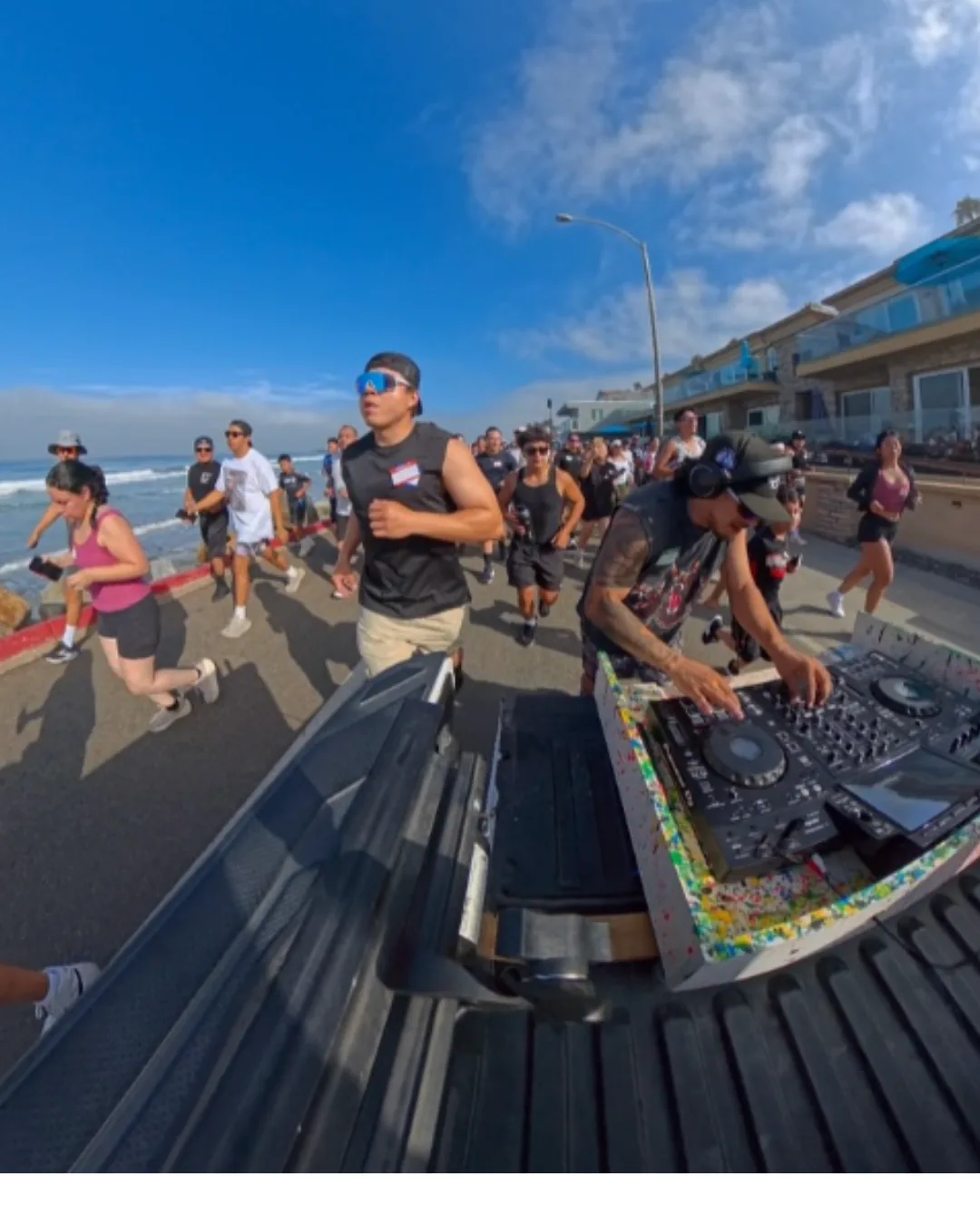
San Diego has dozens of these, which isn’t much help when you’re nervous about the first one. So here are four that are genuinely easy to walk into by yourself, and why each one is like that.
| Club | When and where | Why start here |
|---|---|---|
| Front Runners and Walkers | Tue and Thu 6:00pm, Sat 8:00am, Balboa Park | Walking is right there in the name, so you're never going to be the one holding it up. 3 to 4 miles, or a 10K if you walk it |
| Pacific Beach Run Club | Wed 6:00pm, Sat 8:30am, 1376 Felspar St | They actually publish how the no-drop bit works, which is rare. The leader holds about 9:00 per mile and stops four times so the back can catch up, and Saturday 8:30 is the social 5K rather than the long one |
| Milestone Running | Mon 6:00pm in Pacific Beach, Wed 6:00pm in North Park | A run shop club, so there is always staff on the door who will actually clock that you are new. 3 to 5 miles and a raffle after |
| Pacific Coast Run Club | Wed 6:30pm, Sat 7:00am, Buccaneer Park | Up in North County, 3 flat miles of coast, and their own words are all are welcome. It's the one in the photo |
Check their Instagram the night before anyway. Race weekends and holidays move these things around constantly, and when that happens the flyer goes up on a story and nowhere else.
Finding one anywhere else
Most of you reading this aren’t in San Diego, and it works the same way anywhere:
- Instagram first. Search your neighborhood plus “run club” and then read the last three posts rather than the bio, because that’s where the day and the meeting spot actually live
- Then whatever running shop is nearest you. Almost all of them host a weekly run, and it’s the easiest one to walk into cold, since talking to people who wander in is somebody’s actual job
- Strava’s club search by city is useful mostly because you can see how far the group really went last week instead of what they say they do
- The RRCA directory lists registered clubs, which skews older and more organized, usually with a real training program attached
- Or just ask at a local 5K. Half the people there came with a club and they will tell you about it at length
After your first few group runs
If a few group runs turn into wanting a start line of your own, here’s how to pick a SoCal race before the year ends, and the open entry race pickscover the rest of the country, no qualifier and no lottery. If you already lift and you’re trying to work out where the running fits around it, there’s a whole thing on running and lifting in the same week.
Do I need to be fast to join a run club?
No. Most clubs run no-drop, which means the group regroups so nobody gets left behind, and at a typical one you will find 7 minute miles and run-walk intervals at the same event on the same night.
What is a no-drop run club?
One where nobody gets left behind. The front of the group stops at lights and turnarounds and waits for the back, so the slowest runner finishes with everyone else. Most social run clubs work this way.
What if I need walk breaks?
Completely normal. Walk breaks are standard at beginner-friendly clubs and plenty of experienced runners take them on purpose. Run-walk is how a lot of people get through their first 5K, and a fair few marathons.
Is it weird to show up to a run club alone?
That is how most people arrive, honestly. Plenty of people at any given run came on their own, and the clubs that stick around are the ones that got good at spotting someone standing by themselves. Saying you are new when you get there does most of the work for you.
Do I have to talk to people?
No. You can run the whole thing quietly, skip the bar after, and head off from the finish without anyone chasing you down. Most people find talking gets easier once you are moving and not making eye contact anyway, which is probably half of why group runs work.
How far do run clubs run?
A weekday social run is almost always 3 to 5 miles, so 30 to 50 minutes at most paces. Saturday long runs go further, usually 4 to 10 miles with a shorter option leaving from the same spot. Clubs post the distance beforehand, so you can pick which week you turn up.
Do you have to pay to join a run club?
Most are free. Some sell a shirt eventually or charge for a special event, but turning up on a normal week does not cost anything.
What should I bring to a first group run?
Sneakers you can move in, water if it is warm, and your phone. Nobody is looking at your gear.
How do I find a run club in San Diego?
Four clubs that are easy to walk into on your own are listed abovewith their days and start points, in Balboa Park, Pacific Beach, North Park and Oceanside. Instagram is where most SD clubs post week to week, so search your neighborhood plus “run club.” The RRCA club directory lists registered clubs too.